
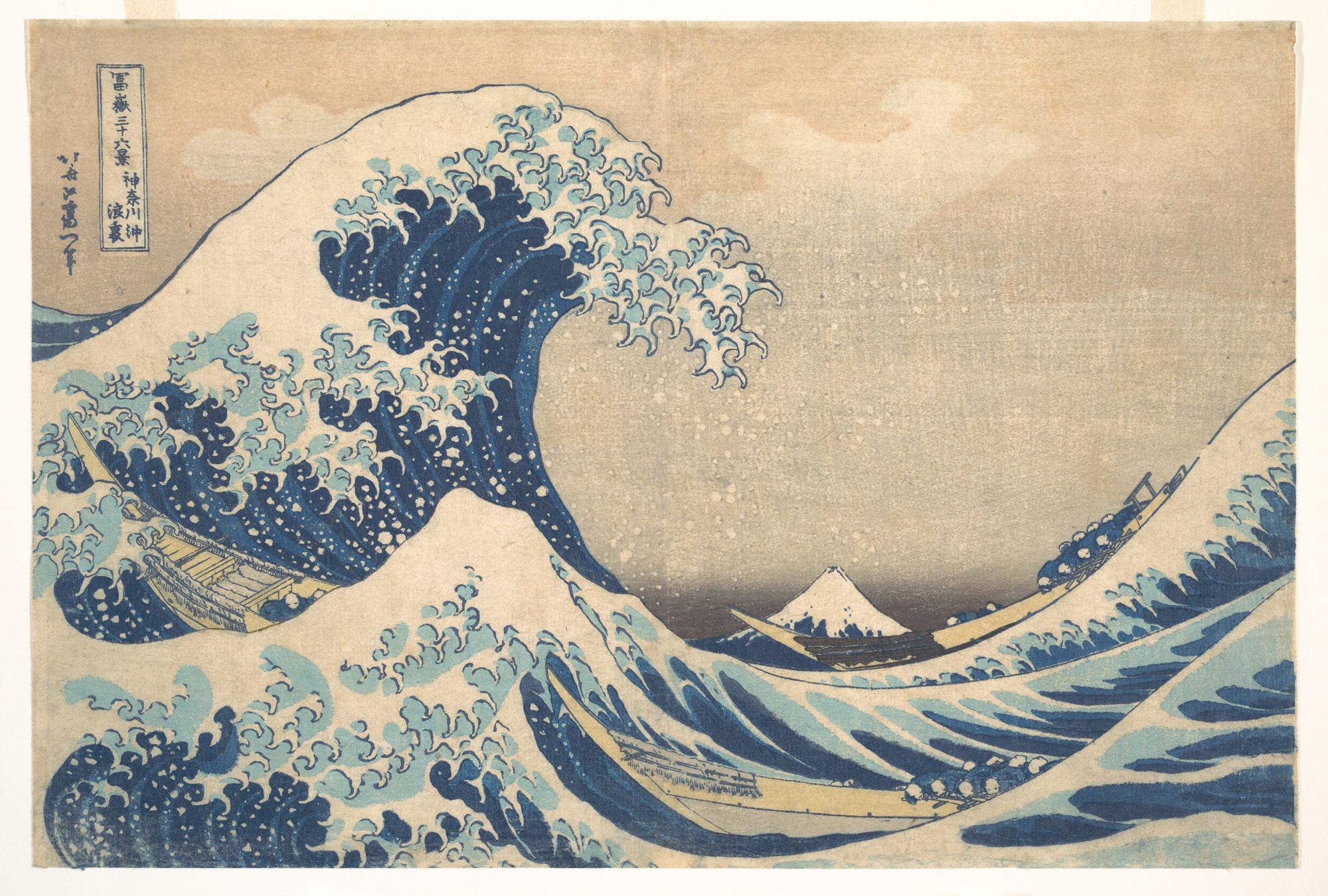
Which work are we looking at?
The Met attributes impression JP2972 to Katsushika Hokusai, dates it to about 1830–1832 and places it in Thirty-six Views of Mount Fuji. It records a woodblock print measuring 25.1 × 37.8 cm. These details describe that historical impression.
Source [1]
When buying a decorative reproduction, the question changes: you are not choosing that museum impression. You are considering a different object that uses its composition. Do not mistake an artist’s name in a title for a guarantee about who printed the object, which image was used or how it was made. Those answers need to be established for the particular product.
Why its identity as a print matters
The Met’s essay on ukiyo-e describes images transferred to carved blocks, inked and printed onto paper; separate blocks were used for multiple colours. That historical technique does not identify how a modern reproduction was manufactured.
Source [2]
Our practical conclusion is straightforward: we would not demand brushstroke texture from a canvas reproduction as proof of fidelity. We would first establish what it reproduces and how it is presented. A modern material can be a valid decorative choice without becoming the technique of the original.
A visual reading for your room
Our reading of the image focuses on two scales: the wave’s curve occupies much of the field while the mountain stays small in the background. Diagonals and curves lead the eye across the surface. For a corner intended for rest, that visual activity might feel too intense; for a wall needing a focus, it might be interesting. These are interpretations of composition, not guaranteed psychological effects.
Before pairing it with a blue sofa or rug, try a different question: do you want to repeat a colour or introduce an image with movement? Every blue need not match. In our approach, surroundings with fewer nearby objects would give its lines room to read; a wall already full of patterns would call for a more careful scale trial.
Check what remains inside the frame
| Area | What to look for |
|---|---|
| Edges | Are inscriptions and the ends of the composition retained? |
| Centre and distance | Are the mountain and boats still visible? |
| Proportion | Does the image seem stretched or cropped to fill the format? |
| Sides | Does an important part wrap around the stretcher? |
As an independent exercise, imagine a horizontal image with a 3:2 ratio. To fit it completely inside a 60 × 60 cm square without distortion, it would occupy 60 × 40 cm, leaving 20 cm of vertical space in total. Filling the entire square would require another solution, such as cropping. This example does not measure the Met image or describe a listing; it explains why asking about framing is more useful than considering nominal size alone.
What we would check next
We would look for a reproduction whose listing clearly identifies the crop, support and outer dimensions. If it shows only a distant decorative scene, we would request a front view before recommending it. Nor would we use this museum image to promise the colour, detail or finish of the product that arrives.
The image in this guide helps readers study the historical work. It is not a purchased sample or a photograph of an Amazon reproduction. Checking a commercial listing identifies what is advertised; it does not establish product quality. This page declares no winner and includes no affiliate links.
Apply these questions to a specific reproduction: the cuadrosfamosos.es profile
About this guide
This guide brings together specialist sources and advice for choosing art for your home.
How we put this guide together
Source-led research and editorial judgment. We have not bought or tested reproductions; we do not assess the quality of any Amazon product.
Our editorial methodSources
- Under the Wave off Kanagawa — JP2972The Metropolitan Museum of Art ·
- Woodblock Prints in the Ukiyo-e StyleThe Metropolitan Museum of Art ·